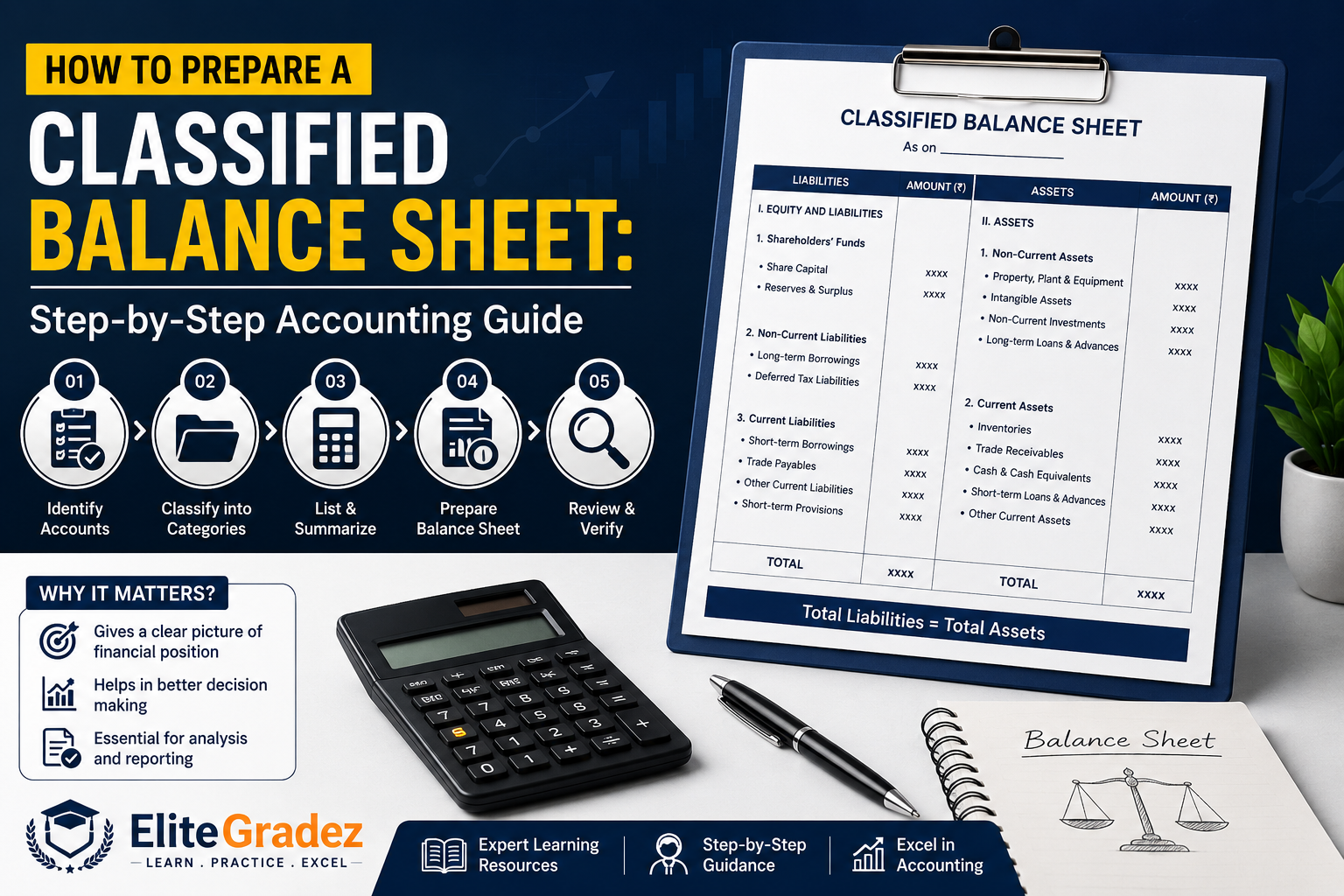
A classified balance sheet is a financial statement that groups a company’s assets, liabilities, and equity into distinct sub-categories—such as current and non-current items—to provide a clearer, more organized picture of financial health. Unlike an unclassified balance sheet that simply lists all accounts sequentially, a classified balance sheet groups accounts by operational lifespan and liquidity, enabling investors, creditors, and financial analysts to evaluate short-term solvency and long-term stability with precision. This guide provides a step-by-step procedural breakdown for accounting students and professionals on how to construct a classified balance sheet in accordance with Generally Accepted Accounting Principles (GAAP).
Understanding the Core Architecture of a Classified Balance Sheet
To prepare an accurate classified balance sheet, one must master the fundamental accounting equation:
Assets=Liabilities+Equity
Every account extracted from the adjusted trial balance must be sorted into specific sub-classifications. Assets and liabilities are strictly divided into current (short-term, typically under 12 months) and non-current (long-term, exceeding 12 months) categories.
“A classified balance sheet categorizes assets, liabilities, and equity into subgroups like current and non-current, aiding comparability and financial liquidity analysis across reporting entities.”
Step-by-Step Guide to Preparing a Classified Balance Sheet
Step 1: Gather and Analyze the Adjusted Trial Balance
Before drafting the statement, compile all ledger account balances after adjusting entries have been made at the end of the accounting period. Ensure that the total debits equal total credits. Identify the company name, the title of the financial statement (“Classified Balance Sheet”), and the specific reporting date (e.g., “As of December 31, 2026”).
Step 2: Classify and List Current Assets (Order of Liquidity)
Current assets are cash and other resources expected to be converted to cash, sold, or consumed within one year or one normal operating cycle. They must be listed strictly in order of liquidity—how quickly they can be converted into cash.
- Cash and Cash Equivalents: Currency, bank accounts, and short-term highly liquid investments.
- Marketable Securities: Short-term investments in stocks or bonds.
- Accounts Receivable: Money owed by customers for goods or services sold on credit (less allowance for doubtful accounts).
- Inventory: Goods held for resale in the normal course of business.
- Prepaid Expenses: Advance payments for expenses like insurance or rent covering upcoming periods.
Step 3: Classify and List Non-Current (Long-Term) Assets
Non-current assets provide economic benefits over a timespan exceeding one year and are not easily liquidated. They are grouped into standard sub-headings:
• Long-Term Investments: Stocks, bonds, or real estate held for long-term growth.
• Property, Plant, and Equipment (PP&E): Tangible fixed assets used in operations (e.g., land, buildings, equipment) reported net of accumulated depreciation.
• Intangible Assets: Non-physical assets with long-term value, such as patents, copyrights, trademarks, and goodwill.
Step 4: Classify and List Current Liabilities (Order of Maturity)
Current liabilities are obligations due within one year or one operating cycle, which will require the use of current assets or the creation of other current liabilities. They are listed in order of maturity.
- Accounts Payable: Short-term obligations due to suppliers for raw materials or inventory purchased on credit.
- Short-Term Notes Payable: Promissory notes due within 12 months.
- Accrued Expenses: Unpaid expenses incurred during the period (e.g., wages payable, interest payable, taxes payable).
- Unearned Revenue: Cash received from customers for goods or services to be delivered in future periods.
- Current Portion of Long-Term Debt: The principal amount of long-term debt due within the coming year.
Step 5: Classify Long-Term Liabilities
Long-term liabilities are obligations whose settlement extends beyond one standard operating cycle or 12 months. Common examples include bonds payable, long-term mortgages payable, and long-term notes payable.
Step 6: Detail Stockholders’ Equity
Stockholders’ (or Owner’s) Equity represents the residual interest in the assets of the company after deducting liabilities. For a corporation, this is divided into:
• Common and Preferred Stock: Par or stated value of issued shares.
• Additional Paid-in Capital: Amounts paid by investors in excess of par value.
• Retained Earnings: Cumulative net income retained in the business rather than distributed as dividends.
Summary of Balance Sheet Classifications
The structural framework of a classified balance sheet is organized as follows:
| Major Section | Sub-Classification | Ordering Principle | Common Accounts Included |
| Assets | Current Assets | Order of Liquidity | Cash, Accounts Receivable, Inventory, Prepaid Expenses |
| Assets | Non-Current Assets | Long-Term Utility | PP&E (Net), Intangibles, Long-Term Investments |
| Liabilities | Current Liabilities | Order of Maturity | Accounts Payable, Wages Payable, Short-Term Debt |
| Liabilities | Long-Term Liabilities | Maturity > 1 Year | Bonds Payable, Long-Term Notes Payable, Mortgages |
| Equity | Stockholders’ Equity | Ownership Claim | Common Stock, Retained Earnings, Treasury Stock |
Why Classified Balance Sheets Matter for Financial Analysis
Preparing it goes beyond fulfilling homework requirements; it is vital for financial statement analysis in Accounts. By separating short-term items from long-term obligations, analysts can calculate crucial liquidity metrics, such as the Current Ratio (Current LiabilitiesCurrent Assets) and Working Capital (Current Assets−Current Liabilities). These ratios help stakeholders determine whether a business possesses sufficient short-term resources to cover its impending financial obligations without disrupting operations.
Frequently Asked Questions
What is a classified balance sheet?
It is a financial statement that groups a company’s assets, liabilities, and equity into specific subcategories (or classifications) based on their nature and timing. Instead of a simple list, it separates items into short-term (current) and long-term (non-current) groups to show a clear picture of financial health.
How is a classified balance sheet different from an unclassified balance sheet?
It organizes assets and liabilities into specific subcategories like current and long-term, making it easier to analyze liquidity. An unclassified balance sheet simply lists accounts under basic headings (assets, liabilities, equity) without time-horizon sub-classifications, offering only a high-level overview.
How do I prepare a classified balance sheet?
To prepare a it, gather your adjusted trial balance data, sort and subtotal assets and liabilities into current and long-term subgroups, add owner or stockholder equity, and ensure that total assets equal total liabilities plus equity.
